A Display or a Hologram Printer?
A technical and creative comparison of Looking Glass Go and the LitiHolo 3DHP
Looking Glass Go, LitiHolo 3DHP, light-field display, holographic printer, holographic stereogram, parallax
1 Two machines, two optical promises
The names invite a direct product comparison, but the products do not perform the same operation. Looking Glass Go is an electronic light-field display: it emits many calibrated views from a 6-inch panel. LitiHolo 3DHP is a desktop optical printer: it records perspective information with a laser onto photosensitive hologram film. These descriptions follow the manufacturers’ technical pages, not the broad popular use of “hologram.”
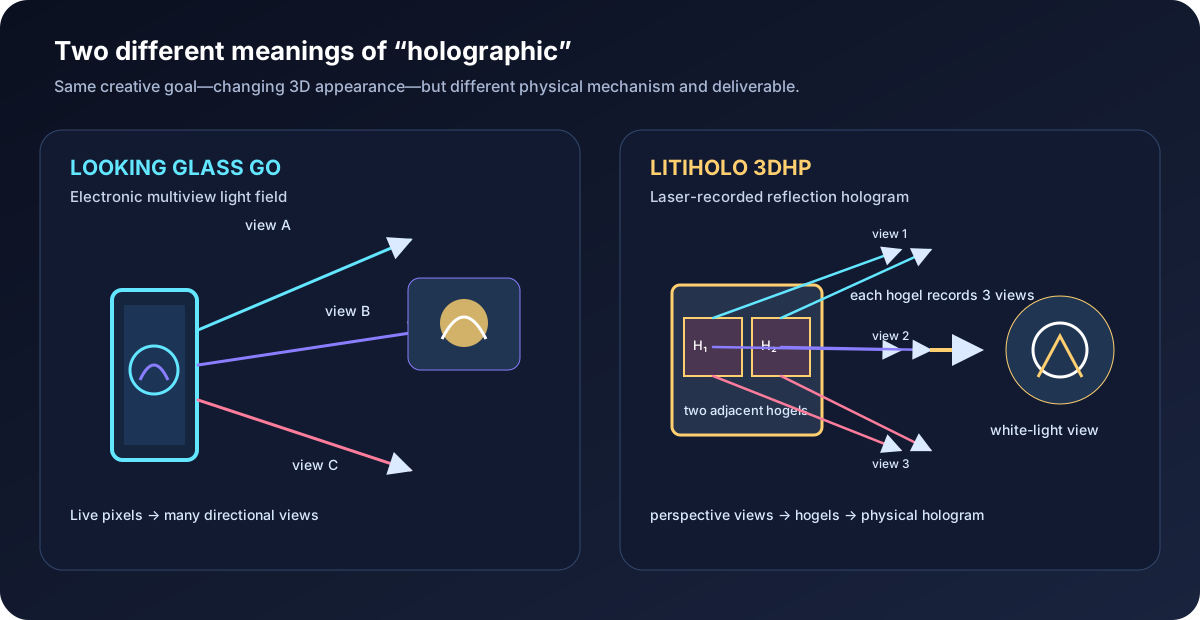
The practical consequence is fundamental: Go is a reusable, dynamic endpoint for digital content, while the 3DHP produces a physical, viewable artifact. The former is closer to a calibrated multiview monitor; the latter is closer to a small-format holographic recording laboratory in a desktop enclosure.
2 Looking Glass Go: from Kickstarter to research tool
Looking Glass Go was introduced through a Kickstarter campaign running from 5 December 2023 to 16 January 2024. Kickstarter describes it as a portable holographic display for spatial memories; the campaign closed with 2,365 backers and US$680,940 pledged against a US$50,000 goal. Looking Glass’s January 2024 retrospective describes the campaign as raising more than US$600,000 in one month. These are campaign records, not current retail specifications.
Alaric Hamacher, the author of this article, was one of the first backers of the Looking Glass Go campaign. That early access connects the device to his ongoing work in volumetric capture, stereoscopic imaging, digital holography, and immersive content creation at Kwangwoon University. The university’s Holography 3D Contents program describes training and research in 3D content production, holographic principles, holographic stereograms, and hologram fabrication. Its faculty profile lists Hamacher’s teaching and research areas as stereoscopic 3D, VR/AR content, and 3D content production.
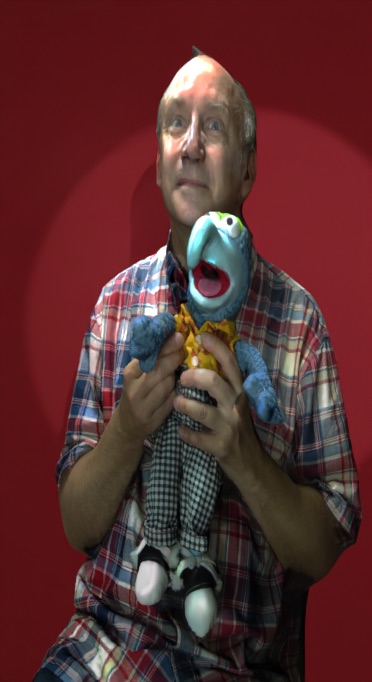
In that context, Go is not only a consumer display. It is a compact research and authoring endpoint for testing how captured or rendered volumetric content survives the transition from cameras and software into a glasses-free multiview display. The Gonzo self-portrait below is an example of this type of workflow; BlueGirl, discussed earlier, represents the parallel physical-hologram track.
Sources: Looking Glass Go Kickstarter campaign, Looking Glass 2024 campaign retrospective, Kwangwoon University Holography 3D Contents program, and Kwangwoon 3D Film Lab / immersive-media research.
In this article, “hologram” is used in the product names and in the vendors’ descriptions. In the optical classification used here, the LitiHolo output is a laser-recorded reflection hologram, while Looking Glass Go is a light-field display that presents directional views. The distinction matters when comparing resolution, persistence, software, and creative workflow.
3 Technical comparison
The table reports only values published by Looking Glass or LitiHolo. “Not specified” means that the cited product documentation does not state a value; it is not an estimate.
| Property | Looking Glass Go | LitiHolo 3DHP |
|---|---|---|
| Optical class / output | Electronic light-field display; live image on 6-inch panel | Laser printer; physical reflection hologram on self-developing film |
| Size | 6.0 in diagonal; 80.4 mm width; 6.2 mm screen thickness | 21.5 × 20 × 11 in; ≈37 lb; hologram up to 4 × 5 in |
| Image / sampling | 1440 × 2560; 9:16 panel | 1 × 1 mm hogel; 0.5 × 0.5 mm upgrade |
| Views / parallax | Up to 100 views; 58° optimal cone; vertical view count not specified | 23 view-zone images per hogel; 45° lateral FOV; horizontal parallax standard |
| Time behavior | 60 Hz; content replaceable and interactive | Physical plate; several seconds of motion can be encoded |
| Illumination / material | 5 V / 3 A external adapter; no film listed | Enclosed 600–650 nm, ≤20 mW red laser; white-light-viewable film |
| Inputs | Photos, video, quilts, RGB-D, 3D models, Gaussian splats, NeRFs, Unity, Unreal, Blender, web | Camera/video perspectives, 3D renders, capture rail, smartphone 3D-capture apps |
| Software boundary | App, Bridge, Studio, Unity Plugin, SDKs, Model Viewer | Perspective-image input documented; no named proprietary runtime on cited page |
| Proprietary disclosure | Looking Glass says its light-field technology is patented; implementation not published here | Optical engine and film are described; no patent or closed file format identified here |
Sources for the table: Looking Glass Go, Looking Glass software, Looking Glass Model Viewer, and LitiHolo 3DHP.
4 What each device actually does
4.1 Looking Glass Go: a calibrated multiview display
Go accepts a digital scene or a prepared set of views, then uses the display’s optical calibration to send different views into different directions. Looking Glass documents support for quilts, RGB-D media, 3D models, real-time Unity content, and other workflows through its software stack. The device can work in standalone and desktop modes, has 22 GB of visible onboard storage, and requires either a compatible computer or the device’s standalone workflow according to the product documentation.
The creative advantage is iteration. A designer can revise lighting, animation, camera placement, geometry, or interaction and see the result again without consuming a physical master. The technical constraint is that the optical image still originates in the panel and its calibrated viewing cone; it is not a freely viewable recording that can be taken away from the device.
5 Two concrete case studies
The distinction becomes clearer when connected to work produced in the same research and creative ecosystem.
5.1 BlueGirl: the physical hologram
BlueGirl is presented by the Kwangwoon Hologram Center as a hologram printed with a hologram printer. It is therefore a useful analogue for the LitiHolo side of this comparison: the result is a physical optical object, not a live panel whose content can be replaced by sending a new frame. The BlueGirl project also gives the collection a local institutional reference point: holography is not only a product category, but a fabrication practice represented at Kwangwoon University.
For the broader technical context, see the collection’s article Full-Parallax Hologram Rendering, which documents the generation of perspective imagery and full-parallax holographic content. BlueGirl should not be used as a specification for the LitiHolo 3DHP—the linked project page does not establish that it was made with that particular machine—but it is a relevant example of the physical-hologram class.
5.2 Self-portrait with Gonzo: the Looking Glass workflow
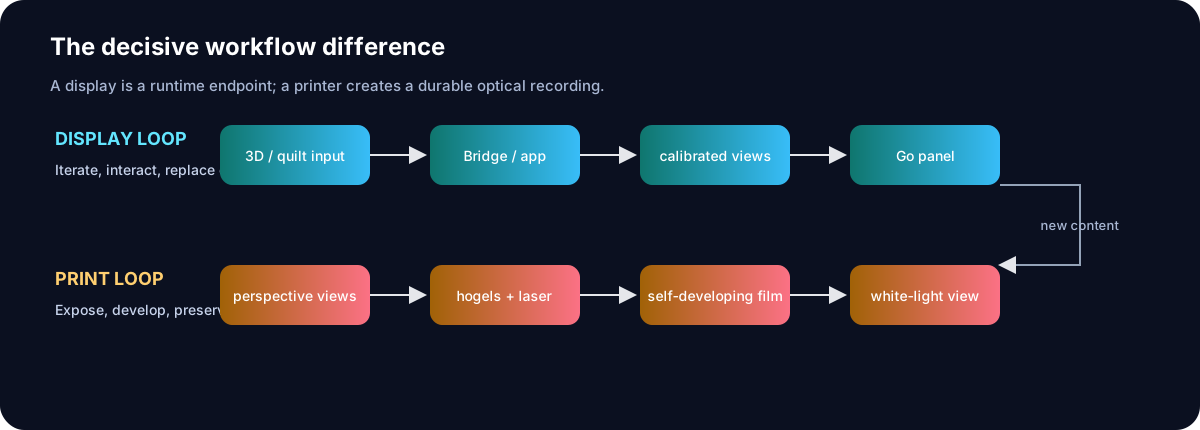
The Self-portrait with Gonzo is a concrete example of the Looking Glass side of the comparison. The project was made from 16 cameras, assembled using Blender, and transferred as a quilt image to Looking Glass Go through Looking Glass Bridge. This is the display-loop model: capture and rendering produce a digital multiview asset; Bridge converts it for the calibrated Go display; the hardware presents the result interactively rather than fixing it onto film.
Open the interactive self-portrait with Gonzo in a separate window.
The collection’s companion article Volumetric Imaging provides the project context. The existing Spatial Media article Lenticular Images and Looking Glass Light Field Displays explains the quilt representation and the role of Bridge in converting multiview content for a Looking Glass display. The Gonzo example therefore connects the abstract pipeline in this article to a documented creative workflow: multi-camera acquisition → Blender processing → quilt → Bridge → Looking Glass Go.
BlueGirl exemplifies the goal of making a physical holographic artifact; the Gonzo self-portrait exemplifies the goal of making a reprogrammable multiview display experience.
5.3 LitiHolo 3DHP: a small-format holographic recorder
LitiHolo describes a pipeline in which multiple perspective images are sliced into recordings for individual hogels, optically encoded with laser light onto special film, and viewed after the film develops. The standard specification is horizontal-parallax-only; LitiHolo lists full parallax, higher hogel density, and tiling as upgrade options.
This makes the 3DHP creatively closer to photographic printmaking than to media playback. Exposure is an event; each film plate records one hologram, and the result can be handled, exhibited, archived, or illuminated independently of the printer. The trade-off is material and process overhead: film plates are consumed, the recorded image is not a software playlist, and a change to the source requires another recording.
6 Resolution is not one number
The two products expose different layers of the imaging chain. Go publishes a panel resolution of 1440 × 2560 and up to 100 display views. The 3DHP publishes hogel dimensions—1 × 1 mm standard and 0.5 × 0.5 mm with the high-resolution upgrade—and 23 view-zone images per hogel. A direct “which has more pixels?” answer would therefore be scientifically invalid: panel sampling and hologram recording elements are not the same quantity.
For a display, the perceptual result depends on panel sampling, optical separation of views, calibration, viewing position, and the rendered content. For a hologram, the result depends on hogel size, the perspective-image set, recording optics, film response, illumination, and the geometry of the recorded scene. The manufacturers publish some of these variables, but not enough to derive a common spatial-resolution figure.
7 Software, openness, and dependence
Looking Glass provides a named software stack: Bridge, Studio, a Unity plugin, SDKs, and a Model Viewer. Its documentation lists model formats including GLB, glTF, FBX, OBJ, STL, PLY, and STEP support in the Model Viewer, with some platform-specific restrictions. This gives Go a clear path from interactive 3D authoring to device output, but the final optical mapping remains tied to the Looking Glass display calibration and software ecosystem.
LitiHolo’s product page specifies the required perspective images rather than a comparable branded runtime. It lists rendered 3D graphics, video frames, camera-rail captures, and smartphone 3D-capture applications as possible sources. That is a more file-oriented boundary: the printer needs suitable views, while the page does not specify a proprietary quilt format, SDK, or model viewer. The safe conclusion is limited: the cited documentation gives LitiHolo an input specification, but does not document a full software stack in the same way Looking Glass does.
Looking Glass explicitly describes its light-field technology as patented, but the supplied public pages do not expose the complete optical design or calibration algorithm. LitiHolo describes its optical engine and film system, but the supplied product page does not identify a patent, file format, or software lock-in. “Not documented here” is the only defensible statement about those omitted details.
8 Creative decision matrix
| If the project needs… | Better fit | Why |
|---|---|---|
| Rapid iteration, animation, interaction, or live 3D applications | Looking Glass Go | The documented 60 Hz display, desktop/standalone modes, and software integrations support a reusable runtime. |
| A small physical object that can be exhibited without the printer | LitiHolo 3DHP | The output is a developed reflection hologram on film. |
| A portrait or model that will be revised repeatedly | Looking Glass Go | Digital content can be changed without exposing another plate. |
| A tactile archival or art object | LitiHolo 3DHP | The workflow creates a physical recorded plate, with film as the medium. |
| Vertical and horizontal look-around in the base configuration | Neither without qualification | Go’s cited page does not state a separate vertical view specification; 3DHP is horizontal-parallax-only unless upgraded to full parallax. |
| A transparent comparison between content pipeline and device output | Looking Glass Go | The Bridge / Studio / plugin / SDK stack is publicly named and documented. |
| A direct experiment in optical hologram recording | LitiHolo 3DHP | Its page explicitly describes laser exposure of hogels onto self-developing hologram film. |
9 Conclusion: choose the artifact you want
Looking Glass Go is the stronger creative instrument when the desired result is a living spatial interface: a small, shareable display for interactive models, depth media, real-time graphics, or rapidly changing experiments. Its value is the loop between software and perception.
LitiHolo 3DHP is the stronger instrument when the desired result is a physical optical recording: a small reflection hologram whose image survives as film after exposure. Its value is not refresh rate or playlist management; it is the act of making and preserving a holographic plate.
They should therefore not be ranked on a single “3D quality” axis. Go optimizes for reprogrammability, software integration, and dynamic viewing. The 3DHP optimizes for physical recording, material presence, and optical-holography experimentation. The right choice follows from the intended artifact: a displayed experience or a recorded object.
10 Sources
All product facts in this comparison are drawn from the following primary sources, accessed 22 August 2026:
- Looking Glass Go product page
- Looking Glass software overview
- Looking Glass Model Viewer
- Looking Glass Windows display settings
- LitiHolo 3D Hologram Printer product page
- LitiHolo Kickstarter campaign
- BlueGirl Hologram in Kwangwoon Hologram Center
- Volumetric Imaging — Kwangwoon University
- Self-portrait with Gonzo — Looking Glass Blocks
- Spatial Media: Lenticular Images and Looking Glass Light Field Displays