Holographic Optical Elements: A Holographic Focusing Screen
Recording optical function for a large-format camera concept
holographic optical element, HOE, holographic focusing screen, ground glass, large-format photography, depth of field, head-up display, transparent camera
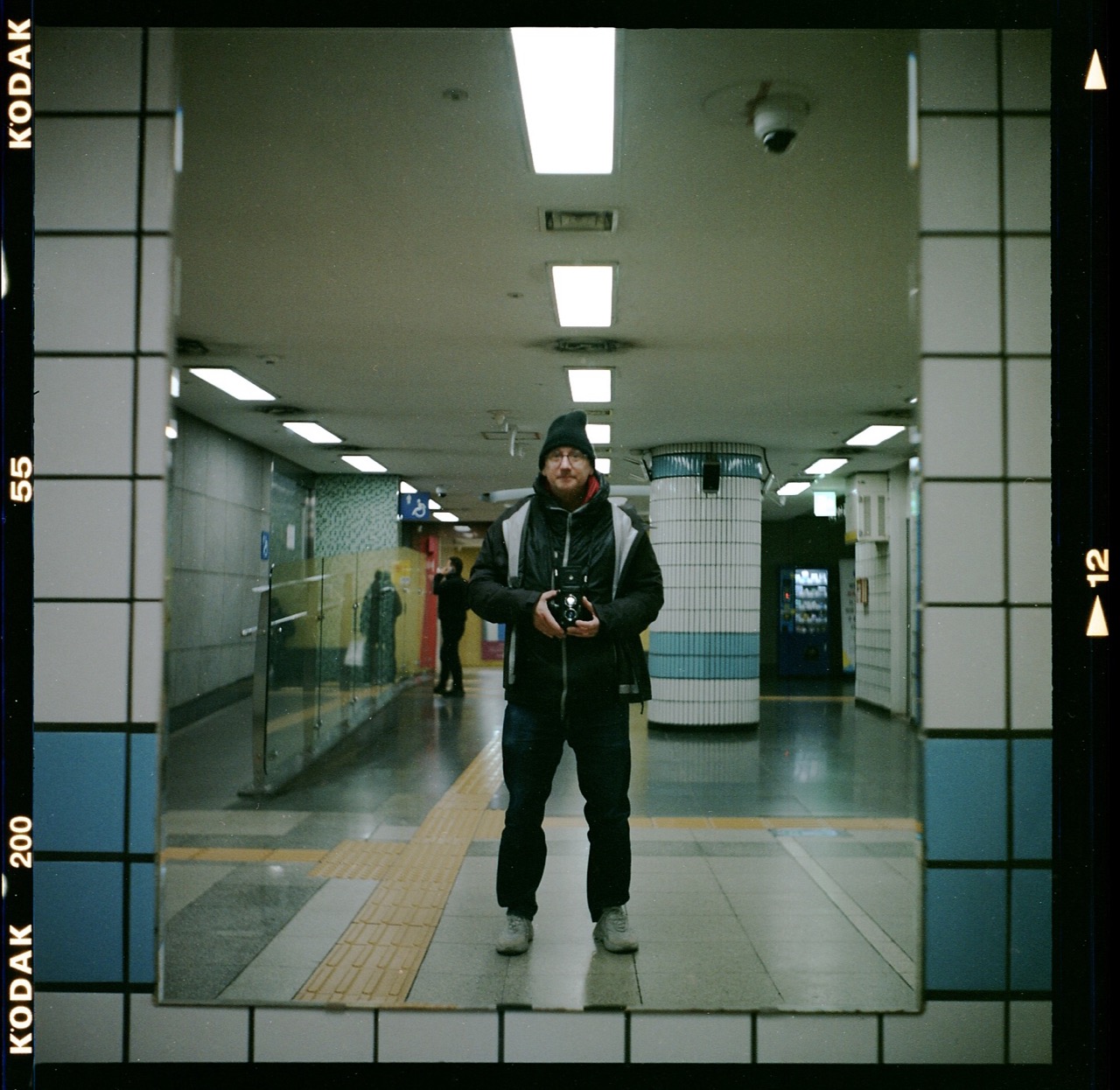
1 From hologram to optical element
Holography is commonly introduced as a method for recording and reconstructing light from a scene. Its important distinction from an ordinary photograph is that the recording can preserve information about the direction and phase relationships of light, not only a two-dimensional brightness pattern. When a hologram is illuminated under the conditions for which it was designed, it can reconstruct a controlled wavefront.
That principle can be used to record an optical function. A holographic optical element (HOE) is not simply an image of a lens or a piece of ground glass. It is a holographic structure designed to diffract light so that the reconstructed wavefront performs a particular optical task. In an appropriate configuration, the result can behave like a lens, mirror, diffuser, grating, or beam-steering element while remaining a thin optical component.
The useful analogy is a magnifying glass: the important property is not the appearance of the glass, but the way it changes the propagation of light. A HOE can preserve and reconstruct a designed optical function rather than merely displaying a picture of that function.
The phrase “a holographic lens” is shorthand. The element does not contain a miniature glass lens in the ordinary sense. Its diffractive structure produces the required wavefront when illuminated with the intended reference geometry. The wavelength, angle, polarization, aperture, and reconstruction geometry therefore matter to the design.
2 Why holographic optical elements matter
HOEs are valuable wherever an optical path must be folded, redirected, or integrated into a surface without adding the bulk of a conventional assembly. This is one reason holographic optical integration has become important in transparent displays, head-up displays, sensing, and mobility systems.
ZEISS Microoptics describes its ZEISS ProSight platform as a proprietary holographic technology platform for optical functions in transparent surfaces. Its listed mobility applications include windshield displays, rear-seat entertainment, and transparent cameras; its aerospace applications include next-generation HUDs and transparent cabin displays. These are industrial examples of the same general idea: the transparent surface becomes part of the optical system.
Not every transparent windshield display is holographic. LG’s UltraView Windshield Display, for example, describes a system combining a compact focus-free AR-HUD with LG’s proprietary Hover Screen. This is a useful comparison: both approaches pursue compact, integrated information surfaces, but the optical implementation can be different. LG’s technical description therefore belongs beside, not inside, the definition of a HOE.
3 A theoretical holographic focusing screen
The following proposal is a theoretical design exercise. It imagines a particular ground glass for a medium-format or large-format camera: a thin HOE that reconstructs a focusing surface while allowing the camera body and the viewing direction to be arranged more compactly.
The idea is not to claim that the supplied diagram is a manufactured product. It is a way of asking a precise optical question: can the focusing function of a ground glass be reconstructed at a useful position and angle by a holographic optical element?
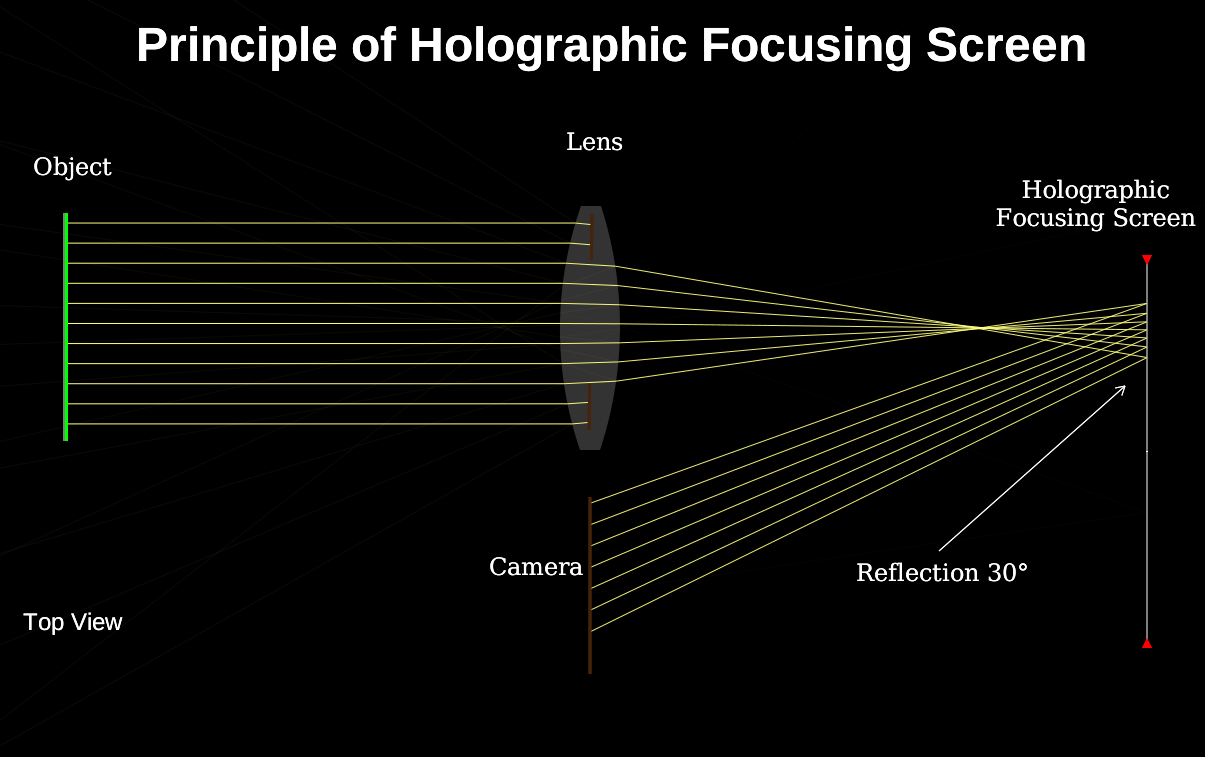
In the illustrated arrangement, the camera can be turned away from the normal orientation of the focusing surface. The HOE is designed to redirect the focusing-screen wavefront toward the camera, potentially saving space in a folded or compact camera architecture. The exact design would require a full optical analysis of aberrations, diffraction efficiency, spectral bandwidth, focus accuracy, stray light, and the viewer’s pupil position.
3.1 What the screen would have to preserve
A practical focusing screen would need to preserve more than a bright image. It would need to provide:
- a stable apparent image plane at the intended focus position;
- sufficient angular acceptance for the photographer’s eye or viewing optic;
- useful brightness and contrast under the camera’s working light levels;
- low enough scatter to judge fine detail;
- a controlled relationship between the lens, screen, and camera sensor or film; and
- mechanical registration that remains stable during focusing and exposure.
These are design requirements, not claims that the theoretical screen already meets them.
4 Why large formats remain attractive
Large sensors and large film formats are popular because format size changes the relationship between field of view, focal length, framing, and depth of field. To obtain a similar framing, a larger format generally uses a longer focal length. At the same framing and f-number, that combination can produce a shallower depth of field and a different rendering of out-of-focus regions.
This is not a simple rule that “large sensors always have less depth of field.” Depth of field depends on format, focal length, aperture, subject distance, framing, and the acceptable circle of confusion. The attraction is the photographer’s control over this complete combination: large-format systems can produce a distinctive separation between subject and background while retaining a large image area.
The F-Zero Camera is a contemporary example of a different optical strategy for pursuing unusually shallow depth of field. Its manufacturer describes a special-optics system with effective apertures from f/0.3 to f/0.6 and a design that accepts cameras ranging from phones and action cameras to DSLR, mirrorless, and cinema cameras. It is not a holographic system. It is a useful comparison because it shows how strongly photographers value control over image-space depth and background rendering. F-Zero Camera describes the product and its optical architecture.
5 The ordinary ground glass problem
The photographs below document the practical difficulty of photographing an ordinary ground glass. The screen is useful to the eye, but it is a diffuse, dim, and often low-contrast object for a second camera. The camera used to document it must be placed carefully, and the photographed result can contain flare, uneven illumination, reflections, and a loss of the detail that the photographer sees while focusing.
The finished photograph demonstrates the visual motivation for the experiment: large-format imaging can combine a substantial image area with a particular depth-of-field character. The following two photographs show the focusing screen itself rather than the final image.
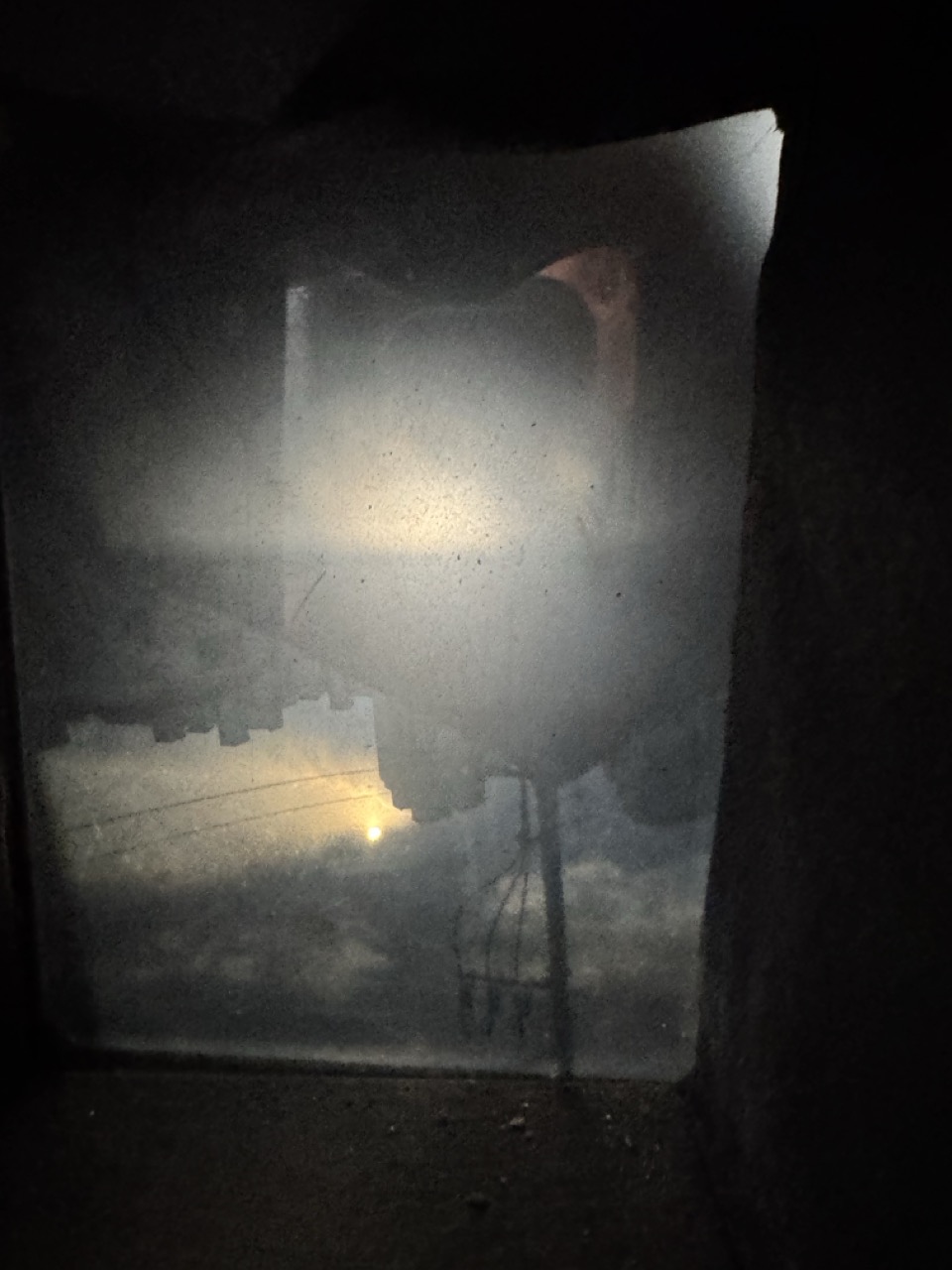
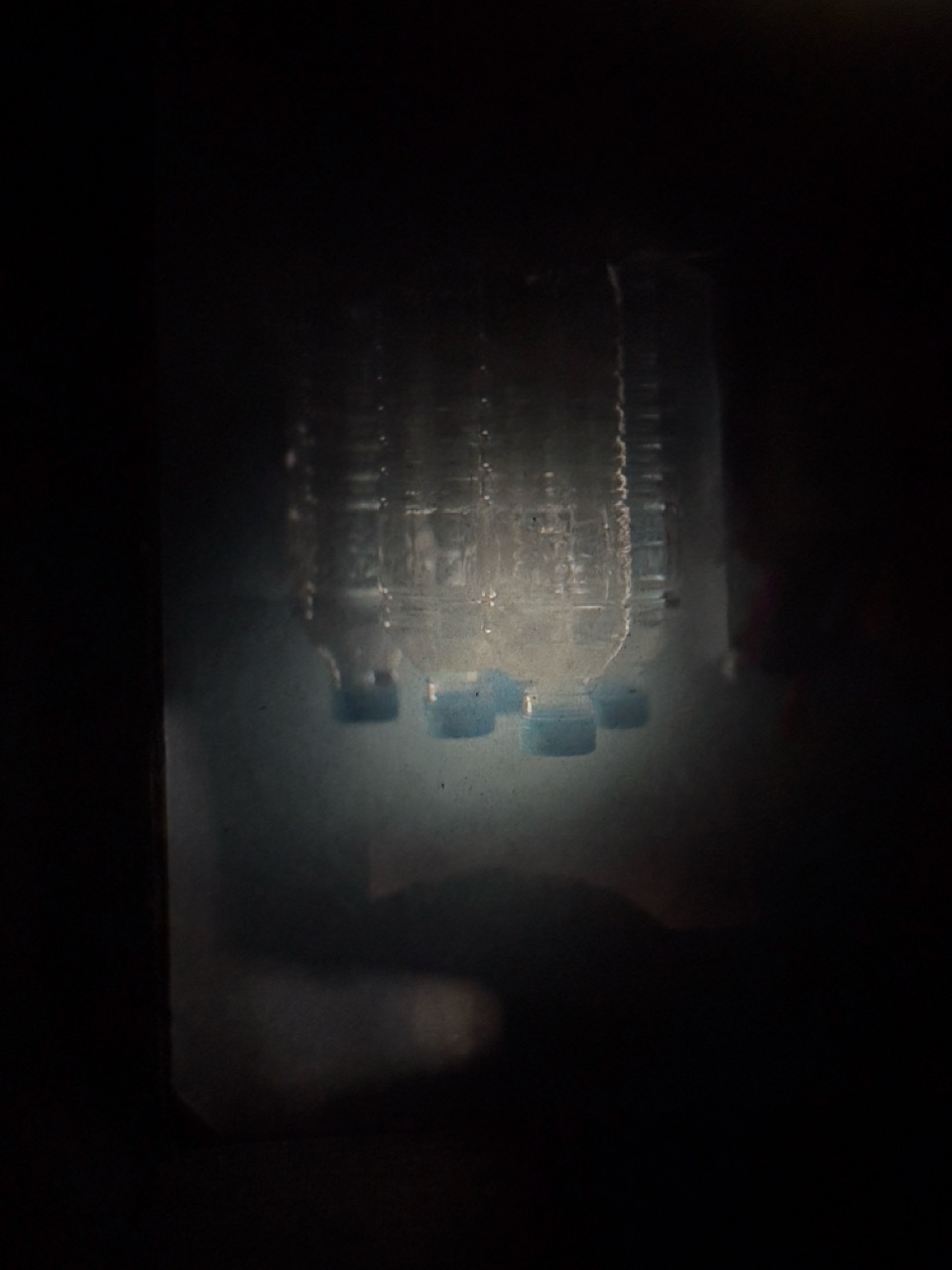
These images are not measurements of a HOE. They are visual evidence of the problem a redesigned focusing surface would have to address: the focusing image can be clear to the photographer at the intended eye position while being difficult to capture, share, or integrate into a compact camera body.
6 A camera built into a window
The broader industrial analogy is a transparent camera. If an optical element can redirect or focus light within a window, the window can become part of the camera architecture rather than merely a protective cover. ZEISS lists transparent cameras among its mobility applications, alongside windshield displays and rear-seat entertainment. The same integration logic appears in HUD systems, where the windshield or a transparent combiner becomes part of the display path.
For the proposed focusing screen, the window is not being used as a display for arbitrary graphics. It is being considered as a precisely designed optical surface that reconstructs a focusing function. That distinction keeps the concept grounded: the objective is not to call every transparent display a hologram, but to identify where a holographic optical element could replace or augment a conventional optical component.
7 Conclusion
Holographic optical elements extend holography from the recording of scenes to the recording and reconstruction of optical behavior. A holographic focusing screen is therefore a meaningful design concept: it asks whether the focusing function normally supplied by ground glass can be reconstructed in a thin, angled, and spatially integrated element.
The concept remains theoretical. Its success would depend on optical design, material selection, mastering accuracy, wavelength, efficiency, contrast, stray-light control, and the geometry of the photographer’s eye. But the question is practical and connected to a larger industrial direction visible in transparent cameras, HUDs, windshield displays, and other mobility systems: turning a surface into an active part of the optical system.