flowchart TD
    A["Capture portrait<br/>iPhone 13 Pro"] --> B["Extract HEIF data"]
    B --> C["RGB portrait"]
    B --> D["Aligned depth map"]
    C --> E["Retouch and color-correct<br/>one source image"]
    D --> F["Create displacement geometry"]
    E --> G["Apply portrait as texture"]
    F --> H["Textured 3D mesh<br/>in Blender"]
    G --> H
    H --> I["Light and refine<br/>the reconstructed portrait"]
    I --> J["Cylindrical virtual camera rig"]
    J --> K["Render horizontal and vertical<br/>perspective images"]
    K --> L["Calculate CHIMERA hogels"]
    L --> M["Print RGB hogels on<br/>Ultimate U04 plate"]
    M --> N["Develop, seal, and illuminate<br/>with an RGB LED"]
    N --> O["Full-color<br/>full-parallax hologram"]

    classDef capture fill:#dcecff,stroke:#3d7db8,color:#17324d;
    classDef model fill:#e5f4ec,stroke:#45936b,color:#173d2a;
    classDef render fill:#fff0d5,stroke:#d0922d,color:#503712;
    classDef print fill:#eee5ff,stroke:#7d5cc4,color:#32234f;
    class A,B,C,D capture;
    class E,F,G,H,I model;
    class J,K render;
    class L,M,N,O print;
Holography in Your Pocket
Generating Full-Parallax Portraits with an iPhone
Holography
How one iPhone portrait, its embedded depth map, Blender, and CHIMERA printing produced a full-color, full-parallax hologram.
Keywords
digital holography, iPhone LiDAR, HEIF depth map, Blender, CHIMERA, full parallax, holographic portrait
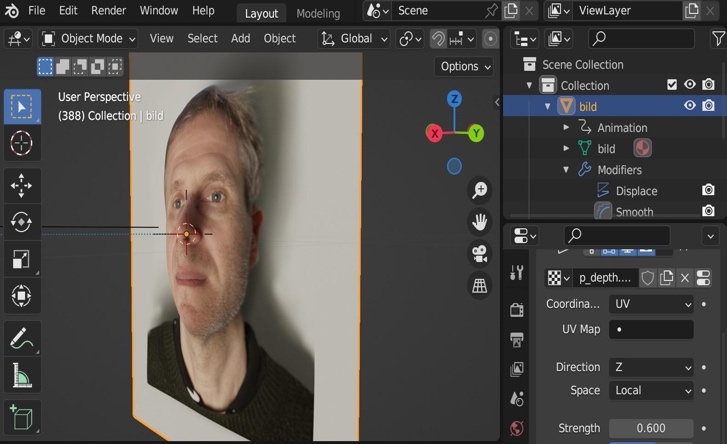
1 A holographic portrait from one phone
Traditional holographic portraits are impressive but difficult to produce. Analog portrait holography commonly uses a high-energy pulsed laser to freeze a living subject during an extremely short exposure. More recent digital techniques replace the single exposure with many synchronized cameras, but the capture system is still specialized and expensive.
Our question was simple: could a single photograph from a consumer smartphone contain enough three-dimensional information to produce a physical, full-parallax holographic portrait?
Together, Philippe Gentet and I developed and tested a workflow using an iPhone 13 Pro, the color image and depth map stored in its HEIF file, open-source 3D software, and the CHIMERA holographic printing process. The result was published in Optics Letters as “Holography in your pocket: generating full-parallax portraits with an iPhone” (Hamacher and Gentet 2025).
TipRead the published paper
The complete peer-reviewed article, its formal citation, figures, and supplementary visualizations are available from Optics Letters / Optica Publishing Group.
Open the article through its DOI. Full-text PDF access may depend on an institutional or personal subscription.
2 Why the iPhone image is different
An ordinary photograph records color and brightness. A recent iPhone portrait can also contain a depth map generated with the help of its LiDAR and computational-photography system. In the HEIF container used for this experiment, the two important elements are:
- a 3024 × 4032 pixel RGB portrait; and
- a corresponding depth map aligned to the same view.
The RGB image supplies the surface appearance. The depth map estimates how far different parts of the subject are from the camera. Together they provide enough information to construct a textured relief-like 3D model.
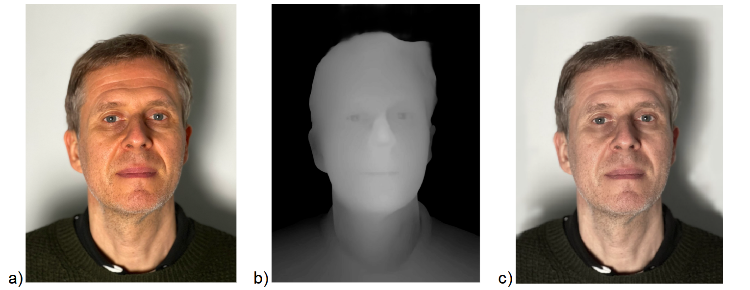
The portrait was photographed against a white background with the phone about 600 mm from the subject. Retouching was applied only to the single source image: color, skin, stray hair, and small image defects could therefore be corrected once, before generating thousands of viewpoints.
ImportantThe depth map is not a hologram
A depth map describes scene geometry. A hologram records or encodes the optical information needed to reconstruct a wavefront. The smartphone data must first be transformed into a three-dimensional scene and then into the many angular views required by the holographic printer.
3 The complete workflow
The key conceptual change happens in Blender. Instead of treating the portrait as a flat photograph, the depth values displace the geometry of a highly subdivided plane. The retouched RGB image is then mapped back onto that surface as its texture.
4 Building the portrait in Blender
The experiment used Blender 4.3.1. The depth map controlled a displacement modifier, while the RGB portrait supplied the color texture. For the reported result, the displacement strength was 0.6 and the midlevel was 0.233. These are scene-specific settings rather than universal values: a different depth encoding or subject distance requires different calibration.
Directional lighting and ambient occlusion were added in Blender. This stage does more than make the preview attractive. The reconstructed mesh allows the artist to refine how the portrait’s form, shadows, and surface detail will read across changing viewpoints.
4.1 Generating full parallax
A stereoscopic image offers two fixed viewpoints. A full-parallax hologram must change continuously as the observer moves horizontally and vertically. The workflow therefore renders the reconstructed subject through a cylindrical virtual camera rig.
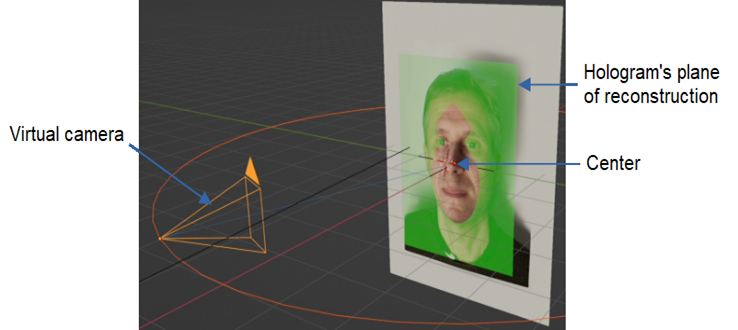
The virtual camera remained 600 mm from the scene, matching the approximate capture distance. It moved around the portrait on a circular arc and also sampled positions from 500 mm above the scene to 200 mm below it. The CHIMERA system can accommodate as many as 768 horizontal views and 128 vertical levels; the portrait reported in the paper used a 120 × 120 grid, producing:
\[ 120 \times 120 = 14{,}400 \]
perspective images. Each image measured 1320 × 1760 pixels.
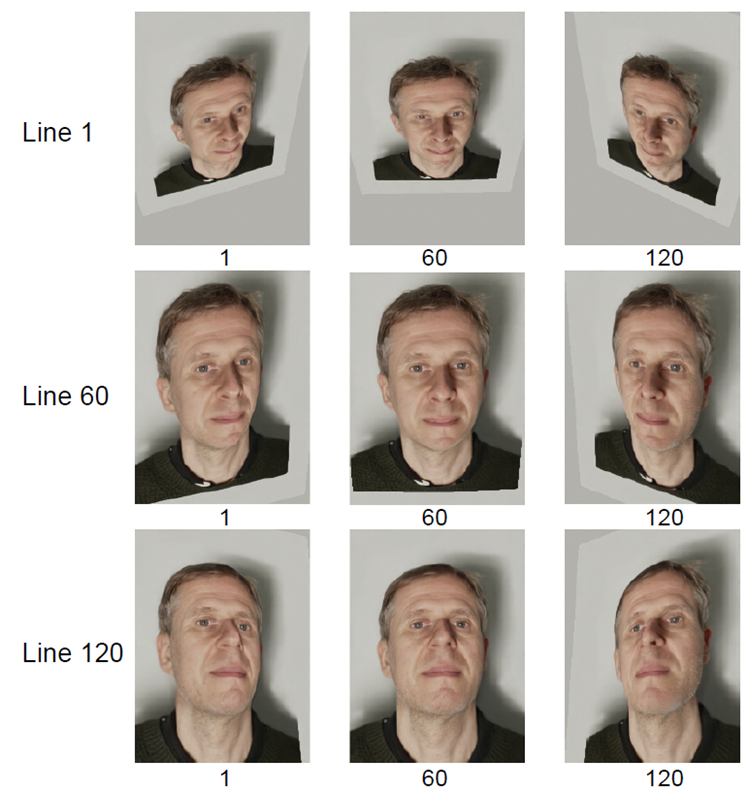
5 From rendered views to a physical hologram
The perspective images were processed by custom software to calculate the hogels—the holographic equivalent of spatially arranged image elements. Each 250 µm hogel was recorded sequentially at 60 Hz with the CHIMERA printing system.
| Printing component | Reported configuration |
|---|---|
| Hologram format | Full-color, full-parallax CHIMERA holographic stereogram |
| Final plate | 15 × 20 cm Ultimate U04 silver-halide glass plate |
| Hogel size | 250 µm |
| Printing rate | 60 Hz |
| Red laser | 640 nm, 20 mW |
| Green laser | 532 nm, 20 mW |
| Blue laser | 457 nm, 20 mW |
| Printing field of view | Up to 120° |
| Reconstruction light | RGB LED, approximately 500 mm away at 45° |
Three spatial light modulators and RGB DPSS lasers encoded the hogels onto an isopanchromatic Ultimate U04 plate. After chemical development, a second glass plate was sealed to the hologram with optical UV adhesive. This stabilizes the emulsion against humidity- and temperature-related thickness changes.
For display, the hologram does not need the original printing lasers. An RGB LED placed approximately 50 cm from its center at an angle of 45° supplies spectral peaks close to the three recording wavelengths.
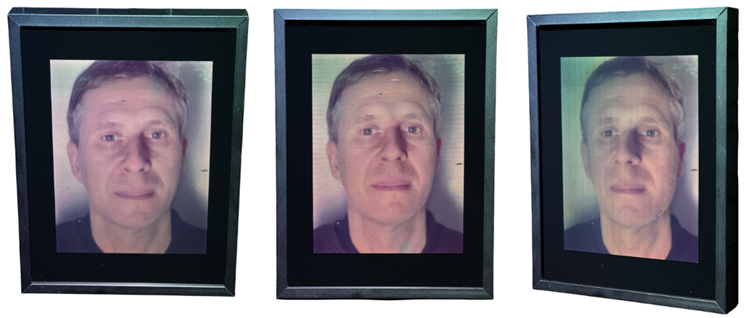
6 What the experiment demonstrated
The printed portrait shows clear facial detail and smooth parallax when the observer changes position. Most importantly, it demonstrates that the acquisition stage of a physical full-parallax holographic portrait can begin with one depth-enabled smartphone image, rather than a pulsed-laser portrait studio or a synchronized multi-camera array.
This makes the method particularly interesting for:
- artists who want to prepare holographic portraits without a specialized capture stage;
- educators introducing the relationship between depth imaging, 3D modeling, perspective sampling, and holographic printing;
- researchers testing consumer depth acquisition as a source for holographic content; and
- archives or studios that want to retouch one master portrait before generating every view.
The smartphone does not replace the holographic printer. What it replaces is the complex capture rig used to acquire the subject’s three-dimensional appearance.
7 Limitations and future work
The final portrait has a slight bas-relief character. A single-view depth map cannot fully describe surfaces hidden from the phone, and its resolution does not reproduce every fine concavity around the eyes, hair, ears, and facial profile. Large viewpoint changes may therefore reveal stretched or incomplete geometry.
Future improvements can address these limitations through:
- machine-learning depth refinement;
- better treatment of hair, boundaries, and missing geometry;
- photometric-stereo or additional-image enhancement;
- testing other phones with time-of-flight or structured-light sensing; and
- a dedicated application that automates HEIF parsing, mesh construction, camera-rig creation, and perspective-view export.
The method is not tied permanently to the iPhone 13 Pro. Any device that provides a usable, aligned color image and depth representation could form the front end of the same pipeline.
8 Publication
Hamacher and Gentet contributed equally to the published research. The article appeared in Optics Letters, Volume 50, Issue 21, pages 6710–6713, and was published online on 28 October 2025 (Hamacher and Gentet 2025).
Alaric Hamacher and Philippe Gentet, “Holography in your pocket: generating full-parallax portraits with an iPhone,” Optics Letters 50, 6710–6713 (2025). DOI: 10.1364/OL.566478.
9 References
Hamacher, Alaric, and Philippe Gentet. 2025. “Holography in Your Pocket: Generating Full-Parallax Portraits with an iPhone.” Optics Letters 50 (21): 6710–13. https://doi.org/10.1364/OL.566478.