Stereoscopic Displays and Applications
The annual meeting for stereoscopic imaging research, technology, and cinema
Stereoscopic Displays and Applications, SD&A, Electronic Imaging, stereoscopic research, 3D Theater
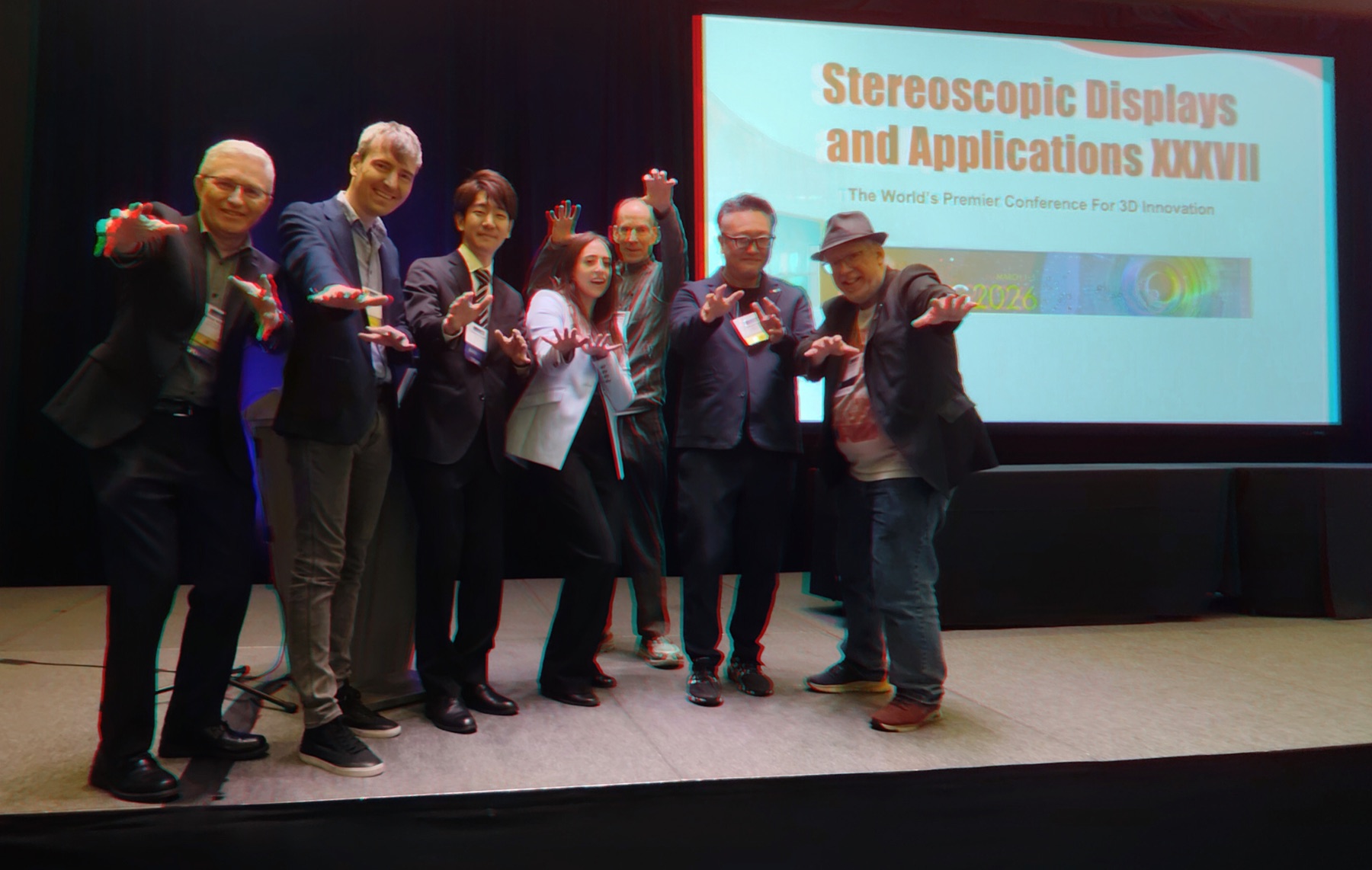
Where stereoscopic research meets the screen
Stereoscopic Displays and Applications (SD&A) is an annual international conference devoted to stereoscopic imaging, displays, capture, perception, visualization and practical 3D applications. Founded in 1990, it brings together researchers, engineers, artists, filmmakers and technology developers. The event is held as part of the IS&T Electronic Imaging Symposium.
The conference is valuable because it connects two parts of the spatial-media world that are often separated: peer-reviewed technical research and the experience of seeing stereoscopic work projected for an audience.
The annual program
The program changes every year but is generally built around several complementary activities:
- Technical papers and invited presentations covering display systems, capture, perception, compression, visualization, medicine, education and emerging spatial technologies.
- Demonstrations that allow participants to experience prototypes and production systems directly.
- Discussion and networking among researchers, manufacturers, artists and stereoscopic practitioners.
- The 3D Theater Session, where finished films, experimental sequences, restored cinema, scientific visualization and production demonstrations are presented on a large stereoscopic screen.
Conference papers become part of the Electronic Imaging proceedings, creating a long-running technical record of developments in stereoscopic media.
The SD&A 3D Theater
The 3D Theater is one of the conference’s defining events. Its purpose is not limited to conventional narrative cinema. A single program may include short films, animation, music videos, scientific and medical imagery, time-lapse, restoration work, industrial demonstrations, trailers and experiments that test new approaches to depth.
The session is organized by John Stern, a pioneer of stereoscopic production and presentation whose work has helped sustain the 3D Theater as a meeting place for filmmakers, researchers and practitioners.
Competition programs recognize outstanding live-action, animation/CG and, when applicable, hybrid work. Demonstration programs allow important examples to be shown without placing them in competition. The archive documents the range of material screened from 1996 onward and notes that the 3D Theater tradition reaches back to the conference’s early years.
Screening length and film length are not always the same
SD&A 3D Theater submissions are generally limited to a presentation segment of about three minutes. That duration describes what was submitted and screened in the session—not necessarily the running time of the complete film. A longer production may therefore appear in the archive as a short excerpt, trailer or specially prepared festival version, and the same work may exist in several cuts.
For this reason, the movie catalog treats a known production year separately from its screening year. When the production year is unavailable, the list shows a clearly labeled value such as “Shown 2024.” The complete screening history remains available under the film’s Details control. A listed duration should be read as the submitted version’s duration unless the source explicitly identifies it as the full film runtime.
2026 edition
The official program places SD&A XXXVII within the 2026 Electronic Imaging Symposium, held 1–5 March 2026 at the Hyatt Regency San Francisco Airport in Burlingame, California. The conference website publishes the current technical program, registration information and calls for future papers and 3D Theater content.
Because dates, venues and submission deadlines change annually, prospective participants should always verify the current information on the official conference page.
The 3D Theater provides a rare opportunity to present stereoscopic work to an audience accustomed to evaluating depth, image comfort and projection quality. Submission instructions for the next program are maintained on the official 3D Theater page.